Thursday, March 19, 2015

TPG Extras 1


So when we aren't doing a review, the wall is FULL of holds and well set problems.  We've decided before we strip the wall for a review, we will film a few of our favorites.  We won't do a full review, but feel free to get in touch with us if you have any questions or want more detailed information on any of the holds featured in these videos.


Friday, January 30, 2015

Kilter Grips Sandstone Series


Sandstone series from Kilter Grips offers 42 holds:

Holds
Without Bolts
With Bolts
(5) Sandstone Large 1

$61.00
$63.00
(5) Sandstone Large 2

$79.00
$82.00
(10) Sandstone Medium 1

$67.00
$71.00
(10) Sandstone Medium 2

$72.00
$76.00
(12) Sandstone Medium 3

$82.00
$87.00

The Sandstone Series from Kilter Grips does it’s name justice.  These holds look AMAZING. Each hold is covered with tiny pockets, dimples, and cracks that mimic the look, texture, and feel of sandstone better than any attempt at this theme we have seen.  On many of the holds these features transition flawlessly from the face of the hold and into the gripping surface. This creates a realistic sandstone feel, while remaining comfortable.  The details on the gripping surfaces create irregularities, making different areas along contact surfaces more or less positive.  Like all Kilter holds we have climbed on, the texture of this line is a perfect dichotomy of grit and comfort, allowing for long sessions that are easy on the skin.

The two Large Sandstone sets are a bit of a grab bag.  Set 1 consists of 3 shallow sloping holds and 2 holds that require some crimping and accuracy. This set was used heavily on volumes during this review, especially on the 50 degree wall.  When used in combination with volumes on the steeper wall problems with these holds ranged from V3-V6. Without volumes you are looking at problems nearer to and exceeding double digits. When used on the 20 degree wall problems ranged from V1-V3.  The variety is really cool, but we would really like to see expansion on each of these ideas into additional sets.  Kilter has assured us that this line will be expanding in 2015!


Sandstone Large 1


The Sandstone Large 2 set features more positive holds. There are 3 flake features that and 2 large pocket features. These holds were at home on the 50 degree wall.  Both pockets are deep and feature a comfortable lip, keeping them as comfortable as pockets can be on the tendons. The flakes worked well on the 50 degree wall without volumes, and are absolutely massive on the 20 degree wall. Both of these sets serve different purposes. From a consumer stand point, Set 1 would be for the home wall owner with slight to moderate incline, unless you have lots of volumes for your steep wall.  If not, then Set 2 would be a better choice.   
Sandstone Large 2

Then there are the Sandstone Mediums - Set 1 and Set 3 are rather similar sets, ranging from mini jug to full pad crimps and even a pinch. These 2 sets were a blast on the 50 degree wall. Most can be used without volumes, and yield problems from V2-V5, with potential for harder problems. 
Sandstone Medium 1
Sandstone Medium 1
Sandstone Medium 3
Sandstone Medium 3
Sandstone Medium 2 consists mainly of shallow slots and a couple crimpy buckets.  This made for more technical climbing on the 20 degree wall in the V3 range without volumes.  They forced accuracy and focus when climbing, producing (with volume use) problems in the V5/V6 range.  Without volumes problems could easily creep into double digits.
Sandstone Medium 2 - Slots
When it comes to criticism, there is not much we can say.  Set screw dimples are not present on Large 2 (the set that needs them most) but are on Large 1 (the set that needs them least).  Aragon plastic takes screws readily without predrilling, so this is not structurally an issue, but Kilter is flirting with perfection here – why not take it all the way? 
As stated earlier, Kilter’s texture is the best in the business, and our set of Medium 3 (while still comfortable) did not seem on par with what we expect from them.  We mentioned it to Kilter, and they asked for some pictures.  They asked for the holds to be sent back, and attributed this discrepancy to old molds being used during manufacturing.  So we took what we considered to be a minor issue, brought it to them, and they insisted on getting to the bottom of it, and will be replacing them for us.  This is a testament to the standard of quality and customer service they strive for.

Bottom line, these holds are not only beautiful to look at, but they climb just as well as they look. They are relatively expensive compared to holds we have reviewed so far, but there is the tradeoff you’ll make as a consumer.  You’re getting what we feel are some of best shapes available, made of high quality plastic, with the best texture we’ve climbed on, and great customer service.  


Tuesday, January 6, 2015

Klutch Holds - Granite Edges Line Review


The Granite Edges line from Klutch features 28 holds:

1 XXL $52 5 M        $32
3 XL       $44 5 S         $26
4 L         $39 10 XS $17

The XXL Feature is the jewel of the line.  We used it on every problem we set in some capacity – sidepull/gaston match on the 20, compression sidepull on the 50, and on volumes as a sidepull and straight ledge.  The gripping surface starts out small and positive on one side and gets wider and slopier as you move to the opposite side.  The surface detailing not only looks awesome, but creates small thumbcatches across the whole hold.  It has a modest hollow back, but it doesn’t really remove enough material to be worth the effort.  It seems like a borderline candidate for a hollow back anyway, because it protrudes at most 2 inches from the wall.  There are unfortunately some serious texture issues here.  There are tiny little protruding shiny bubbles all over this hold.  They reduce grippiness and if you hit them wrong they can actually be painful.  Klutch really needs to refine their molding process before they make any more of these. 


The XL, Large, Medium, and Small edges vary in terms of positivity, but all share a similar footprint and shape.  Again, the surface detail is aesthetic and creates subtle directional thumbcatches – a nice little variation on a standard shape.  7 of the 17 holds in this range are incut and are positive enough for use sans-volumes on a 50 degree wall in the V6 range.  The rest we used on volumes and on the 20 degree wall no harder than V3.  All holds in this line (including the XXL) are really low profile – another perk for homewall and volume use (but creates some structural issues – see below).  They are definitely fun, but it’d be nice to see a little more variety.  The XS footholds are your pretty standard chips in varying degrees of positivity with potential for handholds on volumes, vertical or slab.  They share the granite-like surface texture and round out the line visually as a theme.


The plastic (a urethane casting resin) is quite brittle and chipped readily during drop testing from 5 feet.  The chipping tendency is likely exacerbated by the fact that the holds are so thin.  As an example, one of the Large holds is about 10” long and ¾” deep in the center, tapering out to a knife blade at the edges.  The others are a little thicker, but the knife blade taper is present in most of the holds.  For our standard tightening test, we take holds over to our local gym which features broadly concave concrete walls.  The hold we tested was about 5.5” long – which would require 1 mm of flex (approximately 0.5% of its total length) to come in complete contact with the wall.  The hold snapped in half before contact was established.  You can see this test in the video above.  Any irregularities or concavity in the wall surface will cause problems with these.  Also, despite predrilled set screw holes, we cracked one of the medium holds when tightening a set screw.  There is no washer in the hole, but given how brittle the plastic is, we aren’t sure it would even help.  Bottom line is that this plastic won’t cut it long term – changes need to be made.  

Speaking with Klutch, they plan to switch to polyurethane before any more holds are poured.  We will post an update here on the new material once we test it.


 Overall, we were really impressed with shaping in Klutch’s first line – a subtle twist on standard shapes.  They look great, climb comfortably and are a lot of fun.  Bravo!  However, the manufacturing process and materials need some work for them to make any noise entering the market.  Keep an eye on them though - they have legitimate shaping talent.  

Friday, December 5, 2014

Petrogrips / Synrock - Jugs & Mini Jugs Review


OVERVIEW
Jugs Set A:   $60 - 15 holds
Mini Jugs:     $100 - 50 holds
POSITIVE - inexpensive, ergonomic, great texture
NEGATIVE - durability, lack of color options, heavy

Petrogrips are made out of a material they call Synrock - ceramic material that exhibits real rock texture.  The texture is great and so are the shapes, but let’s just get this out of the way first - There are durability considerations with these holds – no surprises here. Ceramic is brittle and will break/crack/chip more readily than polyurethane or resin holds. 
Tightening instructions are included in each shipment noting that you can’t tighten these like you would with urethane holds – turn until snug, then ¼ turn more.  We thought spinning would be an issue, but following these guidelines we had not a single spinner.  We tightened a few beyond those recommendations (about a full turn past snug) and didn’t break any of them, but an impact driver is out of the question.  The drop test exposed their true nemesis – CONCRETE.  When dropped onto the garage floor from 4’ (a very realistic scenario) one of the largest jugs shattered into many pieces; you can see this test in the video.  The more compact mini jugs fared a bit better in the drop test - some chipping but no catastrophic shattering.  The holds are also relatively heavy – not a huge issue for a home wall owner, but it isn’t feasible to use these in a commercial gym where holds are subject to more abuse and need to be hoisted up in a setter’s bucket.  The holds are not available in vibrant colors – another hindrance for their use in gyms. 
One of the major trade-offs for these characteristics is the price.  15 large jugs for $60, 50 mini jugs for $100 – amazing value.  Holds this size in urethane you’re looking at twice that cost easily.  Even if you break a few, you’re still looking at considerable savings over urethane holds of the same style/size. 
Onto the climbing - for the most part, the jugs are really useful holds.  Set A contains a range of pinches, pockets, standard jugs, and some not so standard jugs.  The range of hold styles would be good for someone who is outfitting their wall for the first time, but customers may benefit from a bit more focus on specific hold types – a set of pinches, a set of pockets, etc.  Petrogrips will accommodate custom orders, but it’d be nice to see such sets available as a standard offering.  All the holds in this set are ergonomically friendly and all gripping surfaces feature smooth large radii.   The texture feels a lot like a fine-grained sandstone – pretty easy on the skin, but you definitely feel the grit when you pop off unexpectedly.  In nearly all cases, the holds are useful in all orientations without introducing contrived or eliminate problems.  On the 50 degree wall we easy set problems in the V2 range, but also set a stellar V6 by utilizing secondary grips.  They lend themselves to the V0-V2 range on the 20 degree wall.  Check out these problems in the video above!

The mini jugs are all over the place in terms of hold type and size.  The set contains everything from a 4 finger 2.5 pad jug to a little 1/2 pad 2 finger crimp.  There are some prominent styles in there though - cool knob features, standard finger buckets/incuts, edges, and some really cool ergonomic pinches.  For the most part, they are all very comfortable - a few odd balls like a one finger thread and a 3 mono pocket hold seem out of place.  You'll get problems in the V0-V3 range on vertical to gently overhanging terrain.  On the 50 degree, the least difficult you could get would be around V3 and they could easily yield some really hard stuff.  We set up to V5 - check out the problems in the video!  They have the same great sandstone texture as the larger jugs.  Just like in the Jugs set, it’d be nice to see some focus on specific hold types to cater to customer’s specific needs.  This set would be a great buy to outfit a home wall for the first time, or for someone who just wants to freshen up their hold arsenal. 


If a home wall owner is willing to commit to treating these holds with considerably more care than their plastic holds, and can deal with the drab colors, buying these is a no brainer: they are fun, comfortable, very versatile, and inexpensive.  Just keep them away from concrete.
Holds are available at synrockholds.com or on EBay from the seller Petrogrips.

Thursday, October 9, 2014

Enix Sandbags Line - Hold Review

NOTE: To better reflect the nature of these holds, Enix has chosen to change the name of this line from Jugs to the far more appropriate name - Sandbags.  

enix logo


The Sandbags line from Enix Climbing offers 26 holds:


  • 10 small- $71
  • 5 Medium- $63
  • 5 Large- $84
  • 5 XL- $?
  • 1 XXL- $48


  • First thing first, these holds are not the typical, sinker, OH THANK GOD! type of jug that one is used to. They do however, offer a positive profile, but lack the full finger wrap that the name jug implies. They range from SMALL to XL, and one XXL feature. The sizes SMALL- XL offer a solid pour construction and the XXL sports hollow back construction, creating an extremely light hold for its size. 


    These holds have a sticky texture, but not on the aggressive side. The radius of the gripping surface combined with the texture, offers comfort for long sessions. These holds will take layers of skin, not chunks. The SMALLs offer 1 – 1.5 pads of gripping surface, and this increases as you progress upwards through the hold sizes. These are workhorse holds. They shined on the 50 degree wall making for moderate to difficult climbing. On the 20 degree wall the difficulty is dialed back. Though, on steep terrain volumes could be used to mitigate the difficulty. 


    Everyone can enjoy these holds, from Gumby to mutant. The geometry makes it easy to force moves to create fun and difficult climbing. There was one issue with the XXL feature that was encountered. The hollow back is aggressive, removing a lot of material. This causes the hold to flex up to 1/4”, as you can see in the video. Enix was contacted, and the mold will be modified to alleviate this issue. The only real drawback is the name…Jugs. This can be deceiving to consumers, and the holds are too unique to be given such a generic name.  That aside, these holds are loads of fun, and every climbing wall should sport some of these “Jugs.”

    Thursday, September 18, 2014

    Groperz Mixed bag


    Groperz Climbing Holds Review from The Proving Ground on Vimeo.

    Back in the day, Groperz holds were the cream of the crop at our Midwest gym – everyone loved climbing on them, setters would fight over them and their shapes were pretty wild for their time (the vast majority were shaped by none other than Tony Reynaldo).  A lot of these holds are still regularly pulled from the hold bins for new routes despite their age and lack of vibrant color from years of acid baths.  The glaring weakness was their relatively slick texture.  Recently, nearly all the classic shapes and a bunch of new ones (most shaped by Tony as well) now feature a grippy texture similar to most holds on the market, which should help bring them back into relevance in the current hold market.

    It must be noted that Groperz plastic, which is a proprietary mix, feels relatively soft and a bit spongy.  Chalk caked on very quickly and shoe rubber seemed to become more embedded than with any other holds we’ve used.  When drop testing them on concrete, the edges chipped pretty readily, and when the chipping occurred, we found we could actually pick off the freshly chipped surface with our fingernails…  When we really cranked them tight on a concrete wall, there were some other issues.  The plastic compressed behind the washer and upon removal there was a 1-2mm gap between the washer and the plastic. This compression also warped the washer which caused some small cracks to radiate around the bolt hole on the back of the hold.  The price tag is certainly attractive, and for some users, these durability shortcomings may not be an issue, but there is certainly a trade off that must be considered.  


    We proceed with the review of the hold shapes and most suitable use, allowing you to make that consideration on your own.   

    Groperz divides their hold line by size but does not use the standard S, M, L, etc.  Their categories are Minis, Footgrips, Poprocks, Keystones, Jumbos and Megalithics.  This isn’t necessarily a problem in and of itself, but the individual sets don’t have unique names – they have a number and letter following the size.  These “names” aren’t memorable and make it difficult to communicate with others about the hold sets.  Some of these shapes have very memorable features, and it seems assigning unique names would be pretty easy.


    The package for review from Groperz included:


    The orange mini-jugs (Keystone 41Aare all 2-2.5 pad incuts with sandstone like surface detail.  Unfortunately, that detailing extends onto the radius of the gripping surface, making for an aggressive texture.  After climbing a few problems set exclusively on these holds, we all felt a bit raw.  This was more of an issue on the 50 degree wall, as any texture issue like this is magnified as terrain gets steeper.  This comfort issue could be mediated by backing the surface texture off the grip.  They are all really positive and would work for beginners on vertical walls, VB-V0 on gentle overhangs, no harder than V3 on a steep overhang.  We were surprised at the discomfort, since most other Groperz jugs are so easy on the skin.  


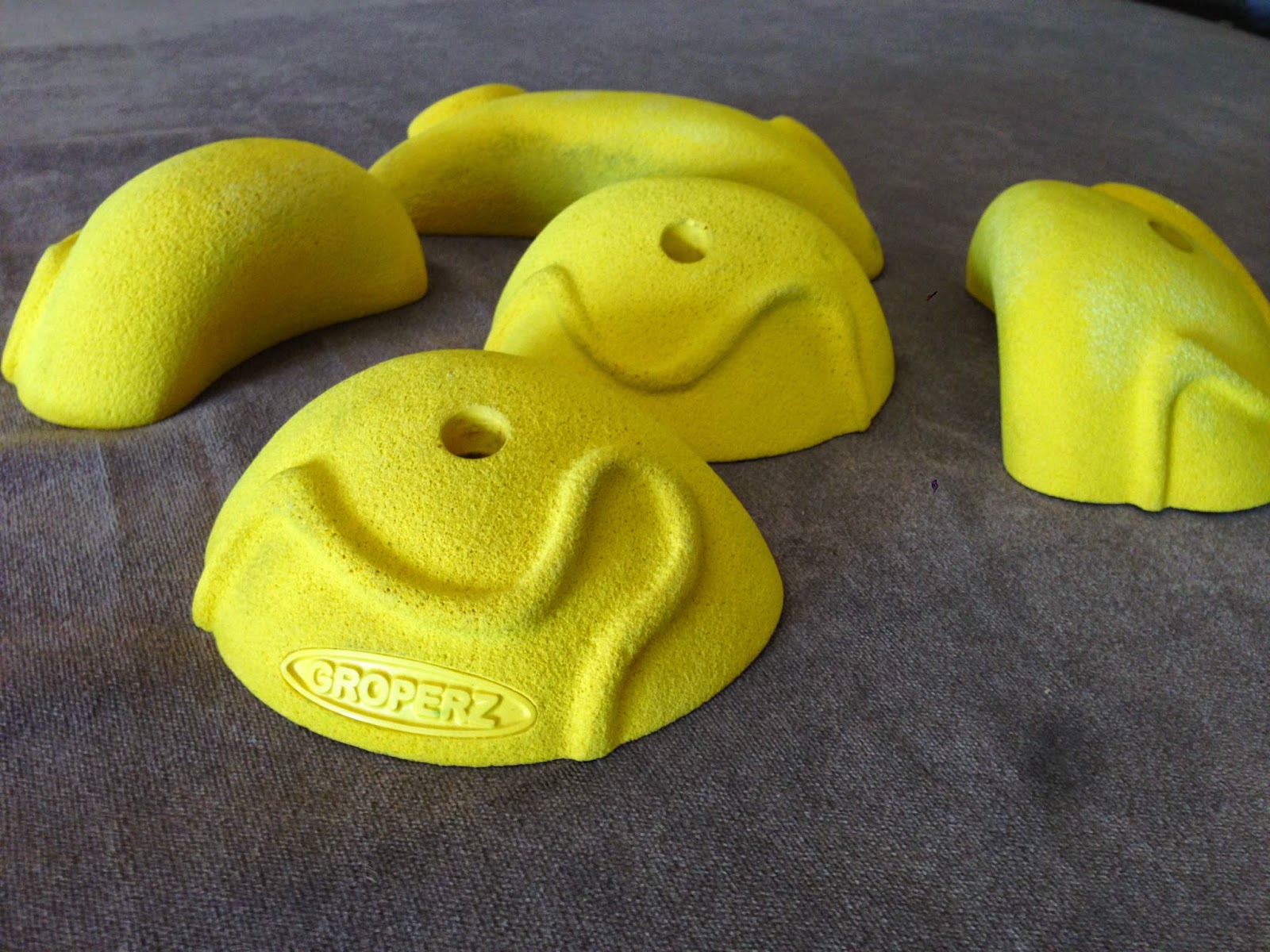
    The yellow sloping jugs (Jumbos 27A) are 2.5-3 pad incuts with a very large comfortable radius.  They are all large enough to warrant a set screw hole, yet 3 of them are without.  They have a worm-like protrusion on the front that makes a great thumb catch and would make for a perfect name for this set – WORM JUGS!  The hollow backs are impeccable and are pretty aggressive with how much material is removed.  The degree of incut varies, but all are pretty positive.  They surprised us on the 50 degree wall – deceivingly difficult!  They lend themselves well to the V3-V4 range at this angle, and would be downright nasty on a roof.  These were easily our favorites in this review.


    One of the holds was VERY poorly sanded, resulting in nearly a ¼” of wobble on a flat surface.  This is a serious quality control issue considering Groperz knew these holds were sent for review.  We informed them of the issue and they apologized and offered a replacement and some additional free holds for the inconvenience – friendly people and they handled it very well.


    The slopers (Megalithics 7A) are pretty standard fare.  They are very comfortable, have a set screw hole with a washer, and really aggressive hollow back to minimize weight and cost.  The logo on the largest hold is very large…   It makes the hold pretty much useless when turned upside down.  They also have their logo tastefully featured on the inside of the hollowback which is a nice touch that we’ve seen on larger Groperz holds in the past.  There are some subtle differences in their shape but they are essentially the same hold in different sizes.  On the 20 degree wall, they are basically jugs and on the 50 degree wall they were extremely difficult unless set into compression style moves – the sweet spot for these holds would be right around 35 degrees. 


    The “Batwing” pinches (Keystone 39A) are unlike any holds we’ve seen before.  Groperz’s website refers to them as “ice cream teeth” – noting that they look like soft serve ice cream after you drag your teeth in it.  They feature lots of angles with concave edges between them.  In most cases, your fingers end up splitting, because none of the surfaces are large enough to accommodate all 4 fingers.  As you can imagine, sometimes the split feels great, sometimes it feels awkward.  We used these exclusively on the 20 degree wall and we feel that’s a great angle for them.  On steeper angles, they could yield some super hard moves and would be useful to force some technical footwork.  These shapes are truly a unique offering and deserve a look.


    The
    Poprocks 17A, 17B and Footgrips 12A are shaped in the same polyhedron style.  Lots of angle changes, but all the surfaces are flat.  The Poprocks work well as crimps on moderate overhangs and would make feet positive enough for use in a roof.  Most of them have multiple angles on the crimping edge, which rewards accuracy and control.  These got pretty difficult on the 50 degree wall, but we set a few moves in the V5-6 range.  The Footgrips are quite versatile - multiple slopes are found on all of them, so changing the difficulty is as easy as turning the hold.  They would also work well as handholds on technical vertical routes.  Both of these sets would be at home in some capacity on any wall.